
 Sophia Windsor
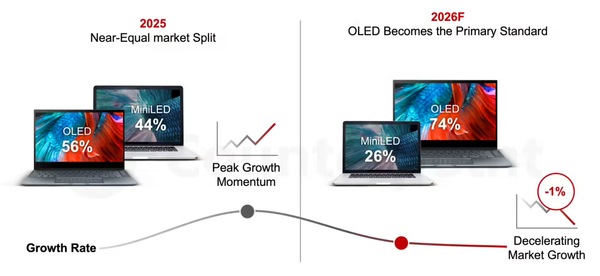
[ Gearbest Technology News]Recently, a survey showed that OLED’s market share in the high-end notebook display field is expected to reach 74% in 2026, while the proportion of traditional LCD in high-end models continues to be compressed. From Lenovo, Asus, Dell to Apple's MacBook Pro, which is about to switch to OLED, almost all high-end product lines of first-tier brands are moving closer to OLED.
OLED
In the development of display technology, the most essential difference between OLED and LCD lies in the way they emit light. Traditional LCDs rely on multi-layer structures such as backlight modules, liquid crystal layers and polarizers to achieve imaging. OLED uses pixel-level self-luminous technology. This fundamental difference in physical level allows OLED to completely surpass LCD.
In the past two years, the penetration rate of OLED in the notebook computer market has accelerated. Global OLED notebook sales will reach 3 million units in 2025, a year-on-year increase of 49%. 2.8K resolution and 120Hz refresh rate have become mainstream configurations. With Tandem OLED technology overcoming the last shortcomings of brightness and lifespan, and AI PC's rigid demand for high-color accuracy screens, OLED's leading position in the high-end notebook field has become irreversible.
So, why do all high-end notebooks now look for OLED screens?
OLED vs LCD
According to Gearbest, the most essential difference between OLED and LCD is the way they emit light. LCD requires a multi-layer structure such as a backlight module, liquid crystal layer, and polarizer to produce images. This means that even if a black screen is displayed, the backlight cannot be completely turned off, and light leakage will always exist. Each pixel of OLED emits light independently and does not require a backlight, which brings overwhelming advantages in terms of picture quality: self-illumination can achieve million-level contrast and pure black performance. Whether watching HDR movies or video editing, dark details can be fully presented.
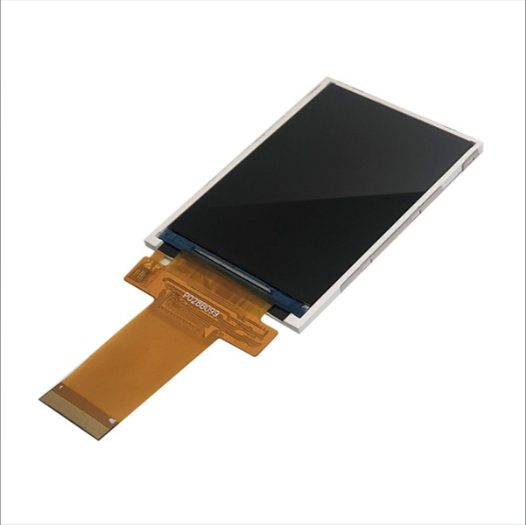
LCD screen
The difference in response speed is equally significant. OLED can achieve microsecond-level response by directly controlling the pixel current, and there is almost no smear in games and fast dynamic images; LCD relies on the deflection of liquid crystal molecules, so the response speed is naturally limited, and dynamic images are prone to blurring. In terms of power consumption, OLED only emits light on necessary pixels and color points, which can significantly reduce energy consumption in dark mode. According to research data from the Chinese Academy of Sciences, OLED power consumption is less than 40% of LCD, the panel thickness is only about 1 mm, and the weight is only 33% of LCD. These characteristics provide key support for the thin and light design of high-end notebooks.
The panel structure of OLED is also naturally better than LCD. The elimination of backlight modules and light guide plates means that OLED panels can be made thinner, freeing up more space for core components such as batteries and cooling systems, and achieving better performance within a limited body. In addition, OLED has no viewing angle restrictions, and there will be no color cast or brightness attenuation when viewed from any angle. This is especially practical for mobile office scenarios where the screen is often shared with others or used in different postures.
OLED technological breakthrough
Traditional OLED once faced two major bottlenecks in the laptop field: insufficient brightness and the risk of screen burn-in. The SDR brightness of early OLED notebooks is usually below 400 nits, which limits the outdoor use experience. When the same screen (such as the taskbar, Excel table) is displayed for a long time, blue pixels are prone to irreversible brightness attenuation due to lower luminous efficiency and faster attenuation, that is, “screen burn”. Samsung Display research shows that when an all-white screen is continuously displayed, blue pixels decay at a rate up to three times that of red pixels.
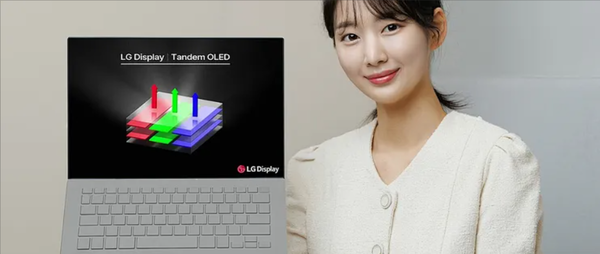
Tandem OLED
The emergence of Tandem OLED technology is fundamentally changing this situation. LG Display first developed the technology to stack RGB organic light-emitting layers into a double-layer structure in 2019, and took the lead in mass-producing the industry's first 13-inch Tandem OLED panel for laptops in June 2024. By connecting two light-emitting layers in series, this technology can extend the screen life to twice that of traditional single-layer OLED, triple the brightness, and reduce power consumption by up to 40%. Flagship models such as Lenovo Yoga Pro 9i have taken the lead in adopting the Tandem OLED solution. The measured SDR brightness is close to 1,000 nits, and the HDR brightness is as high as 1,600 nits. It can compete head-on with Mini LED flagship models in terms of brightness indicators.
The anti-burning mechanism is also being updated simultaneously. Manufacturers such as Alienware have introduced software optimizations such as AI dynamic pixel offset and pixel refresh to effectively delay and balance the pixel aging process. The Samsung E7 panel has improved the blue light pixel life by about 30% through material improvements, further reducing the probability of screen burn-in. The actual failure rate of OLED panels in mainstream models has dropped to extremely low levels, and the concerns of screen burn-in that once troubled users are being eliminated one by one by technological advancements.
The logic of OLED growth
Market data confirms the overall rise of OLED. A Counterpoint Research report shows that global notebook computer display shipments will grow by 7% year-on-year in 2025, and the high-end display market segment will grow by 19%. Looking forward to 2026, the high-end display market is sharply differentiated – Mini LED shipments are expected to fall sharply by 43% due to cost pressures and model iteration adjustments, while OLED displays are expected to grow by 33% year-on-year. The core driving force for OLED growth comes from Apple's plan to adopt Tandem OLED technology in the next generation MacBook Pro. This move will accelerate the penetration of OLED in IT equipment.
At the same time, the popularity of AI PCs has also provided broad application scenarios for high-end OLED screens. According to Gartner's forecast, AI PC shipments will reach 143 million units in 2026, accounting for 55% of the entire PC market. The high average selling price provides sufficient price space for OLED screens, and the stringent requirements for professional color accuracy in AI-assisted creation make OLED's high color accuracy and high contrast a rigid need. Omdia pointed out that under the new trend of AI agents, the self-illuminating characteristics of OLED will be more prominent, and the screen quality is changing from “the icing on the cake” to one of the core competitiveness of AI PCs.
In addition, the 8.6-generation high-generation OLED production lines of upstream manufacturers such as Samsung Display and LG Display are about to be mass-produced, and the panel supply is increasingly abundant, providing a solid supply chain guarantee for the continued penetration of OLED in the high-end market. The TrendForce report predicts that as Apple introduces OLED technology and high-generation production lines are put into production, the penetration rate of OLED laptops will reach 9% to 12% from 2027 to 2028. From technical advantages to cost controllability to ecological adaptation, OLED has completed a complete closed loop from “excellent in the laboratory” to “inevitable in the market”.
Conclusion
Gearbestbelieves that,The full penetration of OLED in the high-end notebook market is the result of the interplay of generational differences in image quality, technology iteration, mature supply chain and the entry of giants. Compared with traditional LCD, OLED has insurmountable inherent advantages in contrast, response speed, power consumption and thin and light design; new technologies such as Tandem OLED further solve the final shortcomings of brightness and lifespan. Apple's MacBook Pro embracing OLED will accelerate this process, and the mass production of upstream high-generation production lines will make cost reduction a predictable reality.
It is foreseeable that in the next two to three years, the battle for screen technology routes in the field of high-end notebook computers will no longer exist. As the high-generation production lines of Samsung Display and LG Display continue to ramp up production, the cost of OLED panels will further decline, and more mid-to-high-end models will follow suit and adopt OLED solutions. For consumers, when buying high-end laptops in 2026 and beyond, OLED is no longer a question of “should I choose it?” but a question of “why not choose it?”


 Login with Google