
 Gearbest Tech

If there are still people in 2023 who doubt that AI PC is a gimmick created by manufacturers to boost sales, then by 2024, the combination of AI and PC has become the general trend. Whether it is chip manufacturers such as Intel and AMD, system manufacturers such as Microsoft and Apple, or OEM manufacturers such as Lenovo, Dell, HP, Asus, etc., they have launched related AI services and regard AI PC as the next hot spot for industry growth.
Qualcomm, one of the world’s largest chip manufacturers, is also making frequent moves in the AI PC field. However, compared to Intel and AMD, Qualcomm’s AI PC line appears more determined and clear. After the release of the Snapdragon In addition, Microsoft has also designated the Snapdragon X series chips as the exclusive chip platform for Windows 11 AI PC, the largest upgrade in the history of Windows, and equipped Snapdragon X Elite and Snapdragon X Plus in Microsoft’s latest Surface Laptop and Surface Pro.

So, what exactly is the “Windows 11 AI PC” defined by Microsoft and Qualcomm? What are the current definitions and standards? Simply put, “Windows 11 AI PC” must meet the following three conditions: 1. The computing power of the processor NPU unit must exceed 40TOPS; 2. It must support Microsoft’s Copilot; 3. There are Copilot shortcut keys on the keyboard.
These three conditions are very simple and easy to understand, but in fact the threshold is quite high, especially in terms of NPU requirements. Most products currently on the market do not have integrated NPU units. In this regard, the Snapdragon X series has significant advantages. Currently, both chips can provide 45 TOPS computing power. Today, not only Microsoft is favoring Qualcomm’s powerful NPU capabilities, but many OEM manufacturers have also launched new Windows 11 AI PC products equipped with Snapdragon X Elite to welcome the new era of Windows systems. What is the difference between a PC using Qualcomm chips and a traditional laptop?
Judging from the test data currently published by various media, we have made several conclusions:
First, higher energy efficiency performance.According to the data given by the Lenovo YOGA Air 14s test used in the machine, the single and multi-core results in CineBench 2024 after turning on beast mode are almost equal to the results of the Intel Core Ultra 7 155H. The prerequisite for the latter to achieve such performance release is that the power reaches 70W, while the Snapdragon X Elite can control the power at around 28W, and the power consumption difference exceeds 60%.
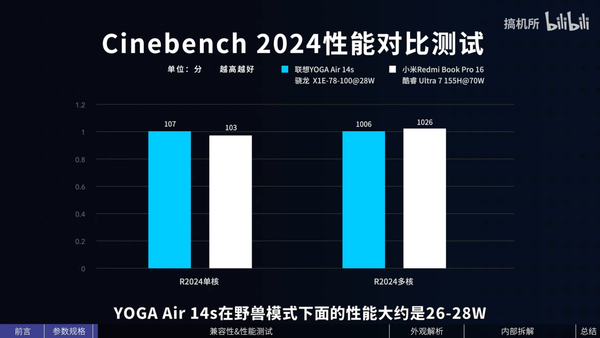
It is worth mentioning that the specific SKU used by Lenovo YOGA Air 14s Snapdragon AI Yuanqi is Snapdragon X1E-78-100, whose maximum CPU frequency is 3.4GHz (the standard frequency of Snapdragon X Elite is 3.8GHz), does not support overclocking (the standard version of Snapdragon Elite is 4.6TFLOPS), which means that the full-blooded Snapdragon X Elite notebook may have better performance and energy efficiency.
The second is, longer battery life. According to the data released by Xiaobai’s evaluation, he used YOGA Air 14s Snapdragon AI Yuanqi (engineering machine). At room temperature of 25 degrees, the resolution and refresh rate were adjusted to the highest. After testing text input, video conferencing, and web browsing for 1 hour, and then playing 4K video online until shutting down, 1 hour of document work only consumed 7% of power, 1 hour of video conferencing consumed 20% of power, 1 hour of web browsing consumed 10% of power, and 63% of the power remained after 3 hours.
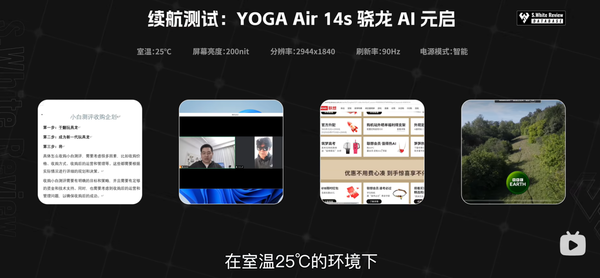
Later, he continued to play the 4K video online for 5 hours and 22 minutes before turning off the phone. It lasted a total of 8 hours and 22 minutes. The test results given by the rice reviewer are even more amazing. He adjusted the notebook to 60Hz+ optimal energy efficiency mode, turned on full Wi-Fi, 200nit brightness, and continuously played the 1080P 60-frame video from Station B (barrage on). The machine was able to play continuously for 11 hours and 16 minutes.
Compared with the past X86 platform, this achievement can be said to have greatly improved the battery life pain points of Windows notebooks.
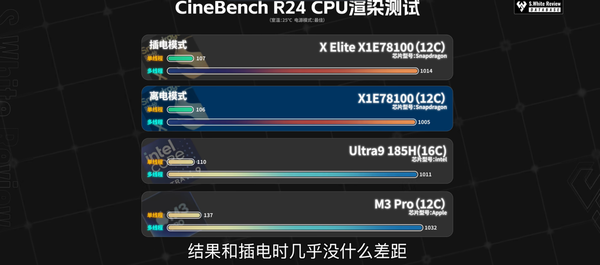
Third, performance release does not depend on “power supply”. According to the data provided by Xiaobai’s evaluation, the Lenovo YOGA Air 14s equipped with Snapdragon X Elite, in the CineBench 2024 CPU rendering test, reached 107 points in 3.4GHz single-threading and 1014 points in multi-threading. The second half of the multi-core frequency stabilized at 2.98-3.2GHz. This result is actually not much different from the Intel Core Ultra 9 version of YOGA, and its multi-threading is also on par with the 12-core Apple M3 Pro. It is worth noting that there is almost no difference in the performance of Snapdragon X Elite when it is powered by battery only and when it is plugged in.
In the test conducted by the Institute of Technology, they also mentioned that when tested with the Office suite under battery conditions, the performance loss when unplugging is quite small compared to plugging in. The performance loss of the previous generation YOGA Air 14s using 7840S is quite large, and the response will be slower when it is powered off.
In fact, notebooks on the Qualcomm platform have maintained excellent unplugging performance since the first generation, and this feature is still maintained on the Snapdragon
Fourth, device-side AI operates more efficiently. According to the test results of the Lenovo AI Yuanqi notebook used in the machine, they used the Lenovo Xiaotian built in the machine to conduct a comparative test. The final performance result was that the native ARM version of Lenovo Xiaotian was better in local real-time dialogue and communication than Core Ultra and other platforms, and LLM conversations were faster.

Of course, many users have previously questioned that compared to the X86 platform, new architectures and platforms often have problems with some commonly used software being incompatible. This is one of the reasons why the X86 platform has a huge market share in the PC market. However, from the current point of view, the problem of basic software compatibility does not exist.
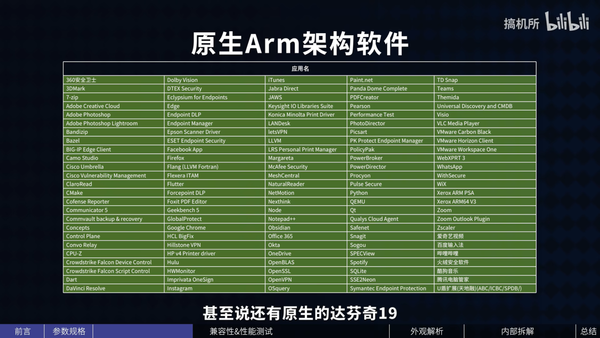
According to the current test results announced by the media, Office three-piece suite, Jianying, Kugou, Bilibili, NetEase Cloud, QQ, WeChat, various browsers, iQiyi, Tencent Conference, etc., software commonly used for daily work and entertainment can all run smoothly. In addition, even native DaVinci Resolve 19 can run directly. Regarding software compatibility issues, Qualcomm has previously stated that it will continue to cooperate with various ISVs to launch native ARM versions for more professional software and continue to enrich the Windows on ARM software ecosystem, not only to meet the light use of ordinary users, but also to meet the needs of professional users. Microsoft is also vigorously promoting the construction of Windows on Arm software ecosystem.
Written at the end: Judging from the current market environment, we have no reason to doubt that AI will bring a new round of changes to the notebook industry. At the key node of AI-driven industrial change, Qualcomm is accelerating the popularization of AI PCs. Of course, “Rome” was not built in a day, and Qualcomm, as a latecomer, also needs to continue its unremitting technological innovation. But judging from the current performance of Windows 11 AI PC, it has become a “pioneer” leading the iterative upgrade of PCs.
magicCubeFunc.write_ad(“dingcai_top_0”);



 Login with Google