

[Gearbest]Among domestic mobile phone brands, Huawei’s influence and market share are in the first echelon. If sanctions had not occurred, Huawei’s global market share might have surpassed Apple’s. On May 16, 2019, Huawei was included in the U.S. trade control blacklist, prohibiting Huawei and 70 affiliated companies from doing business with U.S. companies. In May 2020, the United States imposed a second round of sanctions on Huawei, which were upgraded again in August, putting Huawei in a situation of “no cores to build and no cores to buy.”
Huawei's market share in the consumer business field has dropped sharply, and its smart terminal products have basically bid farewell to 5G. Under heavy pressure, Huawei has embarked on a difficult “self-rescue” operation. From divesting its sub-brand Honor to entering the new energy vehicle market, every step seems to be on the right track and it has maintained its market competitiveness.
On April 20, Huawei held a new terminal commercial office product launch conference and announced that Huawei's consumer business was officially renamed Huawei's terminal business, covering consumer products for consumers and commercial products for governments and enterprises. In the commercial field, Huawei's products include 7 categories: mobile phones, smart screens, tablets, wearables, smart screens, desktop monitors, and notebooks, covering 7 major industries. At the same time, Huawei also launched 7 new terminal commercial office products, including the MateBook B3-420 business notebook and MateStation B520 desktop computer.
New product highlights
-
Huawei MateStation B520
Huawei MateStation B520 is equipped with the 10th generation Intel Core i7-10700 processor with a maximum turbo frequency of 4.8Hz. Its performance is about 30% higher than the previous generation. It integrates Intel UHD Graphics 630 graphics card, which is enough to handle many deep image processing scenarios. The host is equipped with NFC, which can be connected to a mobile phone at the touch of a button to easily share files and achieve real-time interaction across systems. At the same time, Huawei uses the computing power and professional system capabilities of the MateStation B520 to integrate the host and mobile phones into distributed systems. The keyboard, mouse and even the display of the host can be used as peripherals of the mobile phone.
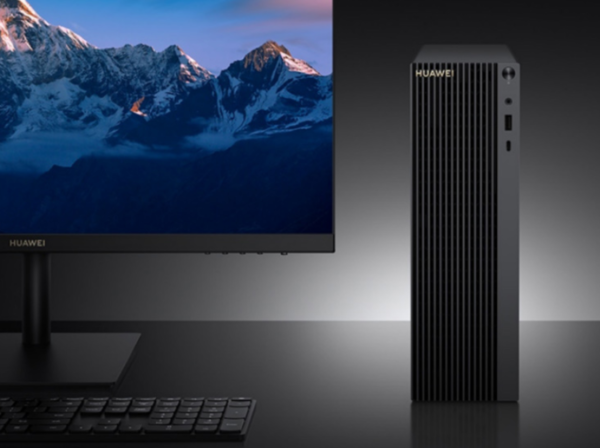
Huawei MateStation B520
-
Huawei Display B3-24 Series
Huawei Display B3-24 series uses a 23.8-inch FHD eye-protecting IPS screen with 1920×1080 resolution, 72% NTSC color gamut, and 1000:1 contrast ratio. It has passed the dual certification of low blue light and flicker-free by Rheinland TV, which can alleviate the discomfort caused by watching the screen for a long time. The back of the monitor adopts a minimalist design, and the thin base supports pitch adjustment, making it easy and quick to disassemble and assemble.
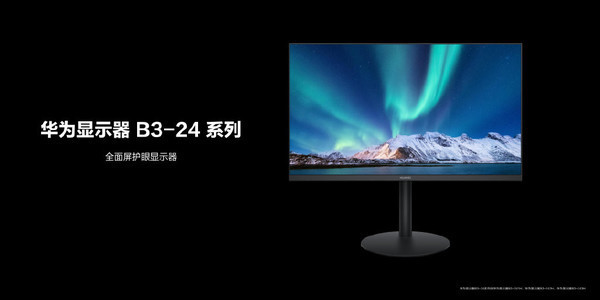
Huawei Display B3-24 Series
-
Huawei MateBook B series
Huawei MateBook B7-410 comes with 3000×2000 The LTPS high-resolution display can achieve 3K-level display effects; it uses a ten-point touch screen with thin Corning Gorilla Glass, an integrated touch solution, and AF anti-fingerprint technology to achieve high-precision multi-touch; the body is CNC drilled and cut, with a refined appearance, high hardness, and is not easy to change shape; the overall size is 304×217×14.6mm, and it is as light as 1.33kg; equipped with the 11th generation Intel Core i7-1165G7/i5-1135G7 processor, the CPU multi-core comprehensive performance is improved by 22%, and it can easily cope with complex application scenarios.
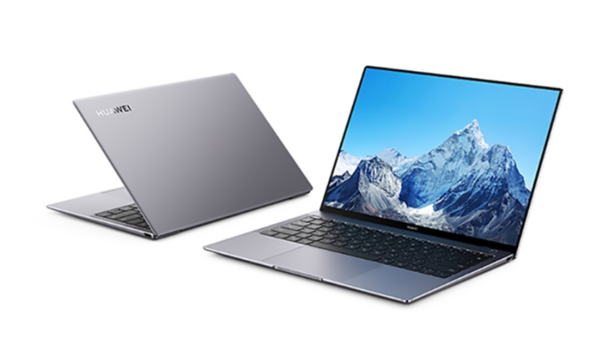
Huawei MateBook B7-410
Huawei MateBook B3-420 is equipped with a 14-inch 1080P full HD IPS anti-glare screen and supports 100% sRGB wide color gamut, narrow bezels of only 4.8mm on the top, left, and right sides, and a screen-to-body ratio of up to 84%; the whole machine is as light as 1.38kg, with the thickest part only 15.9mm, and supports a large opening and closing angle of 180°; using the new 11th generation Intel Core processor, the latest It is equipped with Core i7-1165G7, which improves the overall multi-core CPU performance by 42.6% compared to the previous generation. It has a built-in 56Wh large-capacity battery, which can continuously play local 1080P videos for 10.5 hours, or continuously work for 9.4 hours.
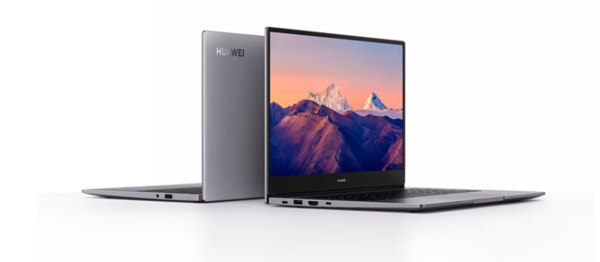
Huawei MateBook B3-420
-
Huawei tablet C series
Huawei Tablet C5 is equipped with a 10.4-inch high-definition screen with 2000×1200 resolution, supporting 225PPI, 70.8% NTSC color gamut, Huawei's exclusive “sharp screen” display enhancement technology, for video playback, picture browsing and other scenes, dynamic algorithm adjustments are made to problems such as picture details and insufficient contrast, so that details in dark areas of the picture are visible. It has a built-in 7250mAh battery, which can stand by for 28 days. It supports 10V/2.25A fast charging and can charge 30% in half an hour.
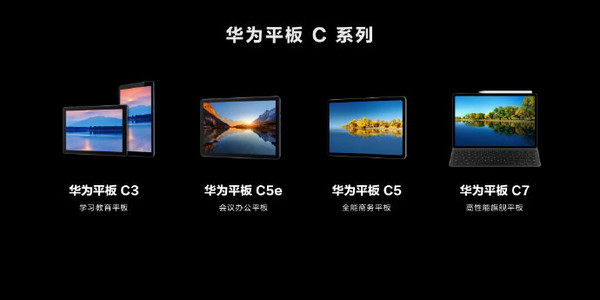
Huawei tablet C series
-
Huawei PixLab B printer
Huawei's PixLab B printer has a single-sided printing speed of up to 30 pages/minute, and it only takes an average of two seconds to print one page. It also supports automatic double-sided printing, eliminating the need to turn pages manually. The printer uses consumables with a toner-toner separation structure, and the toner cartridge can be replaced separately. It also uses a large-capacity toner cartridge with a printing life of up to 15,000 pages. At the same time, the printer adopts an advanced distributed radio frequency solution, introduces a three-layer interference protection network, and combines Huawei's unique Wi-Fi low-power technology to increase network transmission speed by 40% and connection stability by 43%.
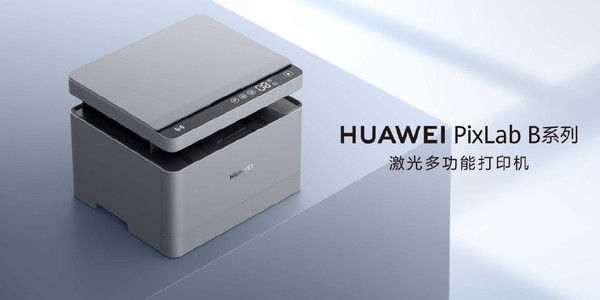
Huawei PixLab B printer
-
Huawei WATCH B series
Huawei WATCH B series watches support rich sports and health data monitoring such as heart rate, blood oxygen, body temperature, sleep, stress, exercise, etc., and support platform-level docking. They can meet the one-stop health data management customization needs of enterprise users and help enterprises accelerate the digitalization of sports and health management.
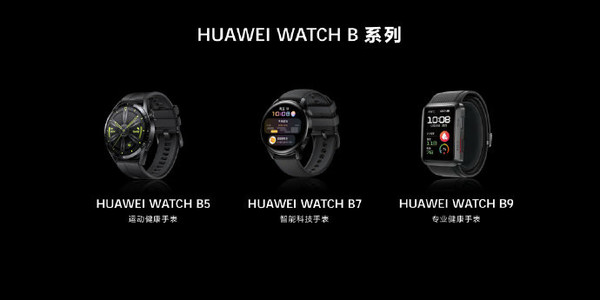
Huawei WATCH B series
-
Huawei Smart Screen B Series
Huawei Smart Screen B3 series has a high screen-to-body ratio of 97.8%, supports 4K ultra-high-definition resolution, and 92% DCI-P3 wide color gamut, bringing cinematic picture detail and quality. Equipped with two 10W high-quality speakers and powered by HUAWEI SOUND sound engine, it brings an immersive sound field experience.
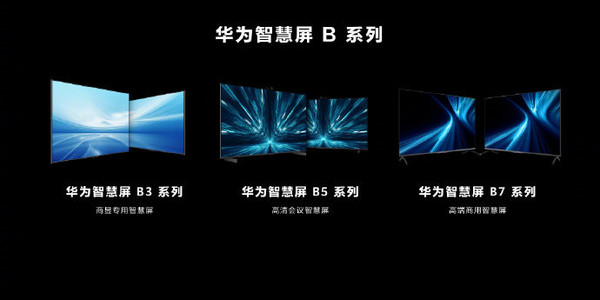
Huawei Smart Screen B Series
Is it the best solution for Huawei to enter the commercial market?
Many people may not understand Huawei's move to change the name of its consumer business, but if you consider Huawei's situation in the past three years, it is not difficult to see that making changes may be Huawei's current “way to survive.” As the market share of mobile phones, the core of Huawei's consumer business, continues to decline, it is not enough to maintain the operation of its huge business. Previously, Huawei announced its 2021 financial report, with consumer business revenue of 243.4 billion yuan, a year-on-year decrease of 49.6%. Compared with 2019, the scale was halved, and the mobile phone market share was only 10%.
Huawei
In fact, Huawei's move can be seen in the annual report. The latest updated business structure shows that the original consumer BG has been changed to the terminal BG. At the same time, Huawei HiSilicon has changed from a second-level department under the 2012 laboratory to a first-level department alongside Huawei's cloud computing and smart car solutions BU, and has become Huawei's three first-level departments alongside Huawei's digital energy business. Huawei is transforming from To C to To B. Compared with the already complete and large C-end market, the B-end market not only has a small user base, but also has heavy pressure from giants such as Lenovo, HP, and Dell. You can imagine how difficult the road will be.
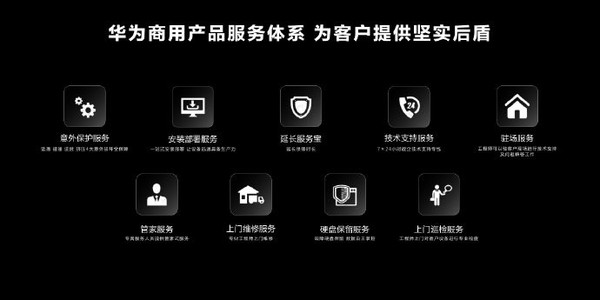
Although Huawei's transformation to the B-side is difficult and long, it is not impossible. Previously, Huawei Terminal has provided numerous commercial solutions to the government and various large and medium-sized enterprises, and has also built a high-standard exclusive service system for commercial customers, such as government and enterprise accident service packages, government and enterprise installation and deployment services, government and enterprise door-to-door maintenance services, etc. The speed of layout progress can be seen with the naked eye. For now, is Huawei's entry into the commercial field the best solution?
Let’s first take a look at Huawei’s previous self-rescue measures. On November 17, 2020, the Honor brand was officially independent. The new Honor draws on the advantages of all parties in terms of resources, brand, production, channels, services, etc. Since Honor is not subject to U.S. sanctions, its current development is booming. Judging from the results, divesting the Honor brand may be one of the important means for Huawei to save itself. On June 2 last year, Huawei launched the 1+8+N smart life solution at a full-scenario new product launch conference. In addition to smartphones, it has in-depth layout in eight major industries such as tablets, PCs, and wearables. It also fully open sourced HarmonyOS 2.0 to further promote Huawei's ecological expansion.
Huawei's self-rescue measures go far beyond this. The results of every important measure are often satisfactory. It can be seen that Huawei has a strong ability to judge future development momentum. Closer to home, although Huawei's entry into the commercial field is seen as a helpless move by many, Gearbestbelieves that Huawei will not make moves that are inconsistent with its development strategy. This transformation may not be the optimal solution, but it is definitely the most reasonable change based on the current situation. Let us use time to confirm Huawei's vision.
magicCubeFunc.write_ad(“dingcai_top_613”);


 Login with Google