
 Gearbest Tech
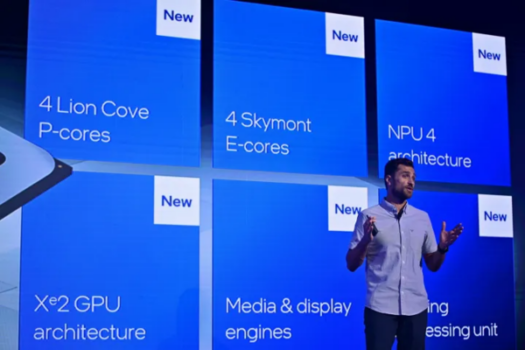
[Gearbest Technology]It is not an exaggeration to say that Lunar Lake is radical. This upcoming chip is different from the Intel products we've seen in the past – those chips that constantly seek the limits in power, core count and clock frequency, but are confused about why laptop battery life can't last a full day. Lunar Lake marks Intel's face-up to past limitations, rather than passive denial. Obviously, Lunar Lake, unveiled at the 2024 Computex conference, is a new starting point for Intel.
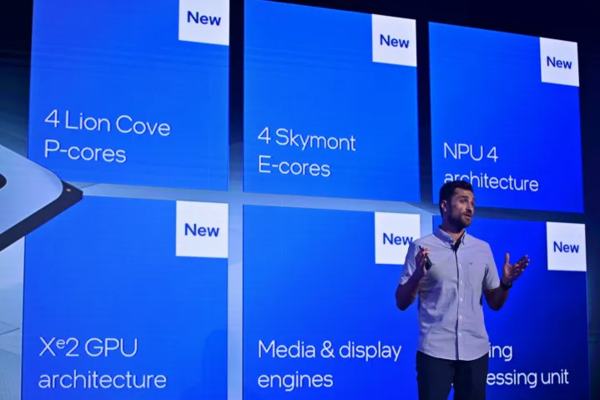
Intel earlier described it as a “disruptive low-power architecture,” and that description is apt. At Lunar Lake, everything is designed around energy efficiency. With this new goal, Intel is freeing itself from the constraints of previous generations of products, discarding technology elements that no longer provide a benefit – even chips that require production in its own fabs.
new focus
For Intel, a key to entering a new era is a new core architecture. Lunar Lake follows a similar hybrid architecture design to its predecessors, but places more emphasis on the Skymont high-efficiency (E) core and relatively reduces its reliance on the Lion Cove performance (P) core. According to Intel, Skymont is the core that drives Lunar Lake.
Intel pointed out that most of the computing on Lunar Lake will be undertaken by the E core. This is different from previous generations of products, which only transferred some low-power tasks to the E core for processing. The P core will step in when it is really needed to provide additional performance support for Lunar Lake, ensuring that it is ready when users need stronger performance.
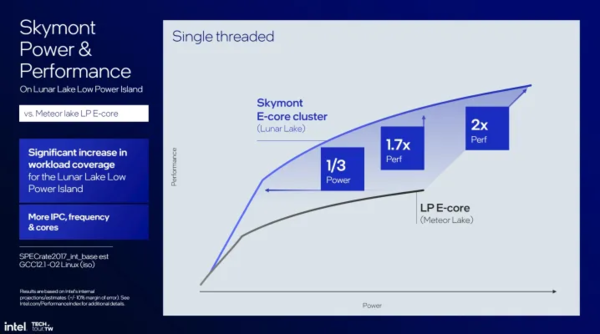
This design is precisely to achieve the performance goals mentioned earlier. In past generations, the E core might only be able to handle a single video stream or very lightweight tasks, while slightly more demanding applications like Microsoft Teams would trigger the P core. But on Lunar Lake, things have changed.
To achieve this transformation, Intel must enhance the performance of the E core. They have set requirements for Skymont's performance: it can provide performance comparable to Meteor Lake's E core while consuming one-third of the original power consumption, and under full load, single-core performance can double.
Intel said Skymont has an average improvement of 2% in instructions per clock cycle (IPC) compared to Raptor Cove. This is a comparison between the new E core for notebooks and the previous generation desktop P core, achieving a performance leap.
This pursuit of efficiency permeates every aspect of Lunar Lake. For example, Intel has separate voltage rails for the P and E cores so that the P core can be completely shut down when not needed. There are also some minor adjustments, such as the E-core's cache being increased to 4MB and being more directly connected to memory.
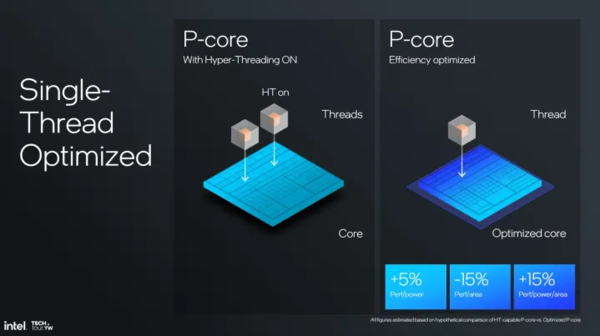
While Skymont is the core driver, the new Lion Cove core also focuses on efficiency improvements. One of the most significant, and perhaps most controversial, changes concerns Hyper-Threading technology. Lunar Lake does not use hyper-threading technology, either E-core or P-core. As Intel puts it: “Hyper-threading is not free.”
Production is handed over to TSMC
The key points here have shifted, but some of the changes Intel made with Lunar Lake are more intuitive. Intel has always designed and produced its own CPUs. But with the Lunar Lake generation, Intel decided to outsource production tasks to chip manufacturing giant TSMC, which also manufactures chips for companies such as Apple, AMD and Nvidia.
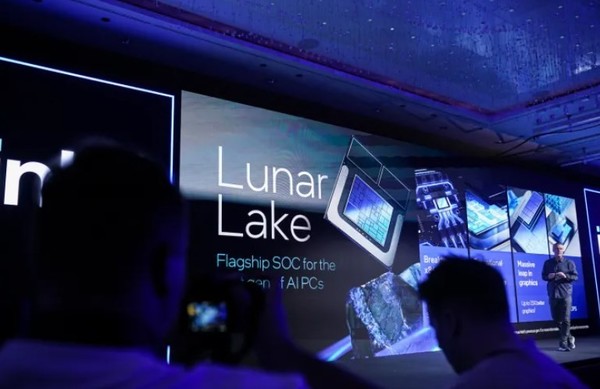
Lunar Lake's core computing module will use TSMC's N3B process, while the platform module will use the N6 process. N3B is a cutting-edge technology node, and Intel currently does not have a corresponding level of process. Instead, Intel is focusing on its slightly smaller 18A node, which it expects to launch next year.
Although TSMC is responsible for producing Lunar Lake, Intel emphasized that this is not out of necessity. According to Intel, such a design is not tied to specific intellectual property rights or production layout, and any manufacturer has the ability to complete it. This is part of Intel's global manufacturing strategy to ensure that production capabilities are not limited to one region but are spread around the world.
Specification
At the heart of Lunar Lake is an eight-core CPU consisting of four high-efficiency E-cores and four high-performance P-cores. Intel says the design is capable of scaling to higher levels but will remain a quad-core configuration. Although the specific model has not been revealed, the specific configuration is still a mystery.
Lunar Lake has significant upgrades in other areas as well. To meet the needs of Copilot+ PCs, Intel redesigned its neural processing unit (NPU). It now has 48 trillion operations per second (TOPS) of processing power, more than four times that of Meteor Lake and even slightly ahead of the Snapdragon X Elite.
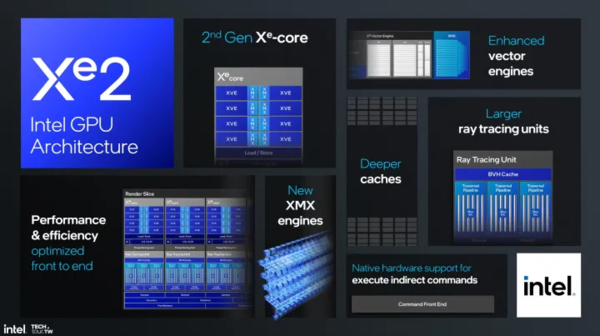
But that's not Lunar Lake's only smart boost. In total, it has more than 120 platform TOPS of computing power. With the new Xe2 graphics architecture, the NPU can provide 48 TOPS, the CPU contributes 5, and the GPU provides 67 TOPS.
The name Xe2 may be more familiar to you as its code name of “Battle Mage”. It is not only adopted by Lunar Lake, but also the graphics architecture of Intel's next-generation desktop graphics card. It is said that the performance is improved by 50% compared to the previous generation.
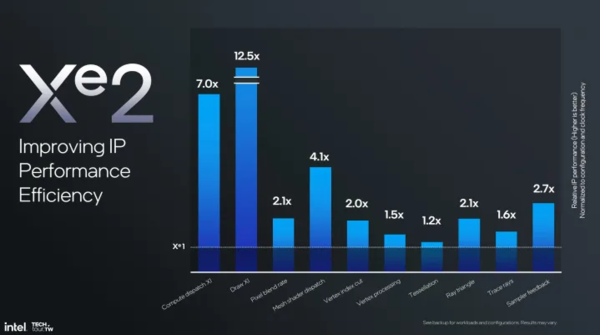
Behind these improvements are various architectural improvements. For example, it natively supports the ExecuteIndirect instruction, which is one of the most commonly used instructions in DirectX 12 games. This alone can bring more than 12 times performance improvement in some cases. Intel has also introduced new compression technology and a faster cache cleaning mechanism to further improve efficiency.
The CPU, GPU, and NPU make up the core of Lunar Lake, but it also contains much more as a complete system-on-chip (SoC). It has a display engine that supports DisplayPort 2.1 and HDMI 2.1, and a media engine that supports AV1 and the new VVC codec. In terms of memory, Lunar Lake can support up to 32GB LPDDR5X.
We won't be able to tell for sure until we see Lunar Lake in actual devices, and a lot of information, including clock speeds and power consumption targets, are still unknown. Intel is talking about architecture, while AMD and Qualcomm are showing off products. The actual performance of Lunar Lake will be a touchstone to test the success of Intel's strategic transformation.
One thing is for sure: Intel is entering a new era. Meteor Lake seems to be an attempt, but within the framework of Lunar Lake, it becomes more meaningful. Through a streamlined core configuration, a persistent pursuit of efficiency, and the use of the best external process nodes, Lunar Lake not only represents a new generation of products, it is a reshaping of Intel's traditional image.
magicCubeFunc.write_ad(“dingcai_top_0”);





 Login with Google