
 Sophia Windsor
[ Gearbest Technology News]According to the latest “China Smart Tablet Retail Market Monthly Tracking” report released by Luotu Technology, omni-channel sales of China's consumer smart tablet market will reach 32.61 million units in 2025, a year-on-year increase of 13.3%. This growth is mainly due to the expansion of national subsidy policies, the centralized replacement of equipment during the peak shipment period of 2020-2022, and the demand for product upgrades brought about by diversified application scenarios.
At the policy level, digital categories will be included in the scope of annual subsidies for the first time in 2025, and the purchase threshold for smart tablets will be significantly lowered, becoming the core driving force for market growth. In terms of replacement cycles, due to the surge in demand for home study and office work during the epidemic, shipments reached a record high from 2020 to 2022. This batch of equipment will collectively enter the 3-5 year replacement window around 2025. In terms of scene expansion, the high-definition of games, the informatization of education, and the normalization of hybrid offices have promoted the transformation of product positioning from a single entertainment tool to a comprehensive productivity carrier, forming long-term growth momentum.
At the same time, the distribution of tablet channels in China shows obvious differentiation characteristics: online channels contribute 65% of sales, and traditional e-commerce platforms such as JD.com, Tmall, and Suning.com account for 45.5% of the market share. The annual sales volume reached 14.835 million units, a year-on-year increase of 15.5%, and the retail sales were 43.31 billion yuan, a year-on-year increase of 21.3%; offline channels focus on experience display and after-sales service functions.
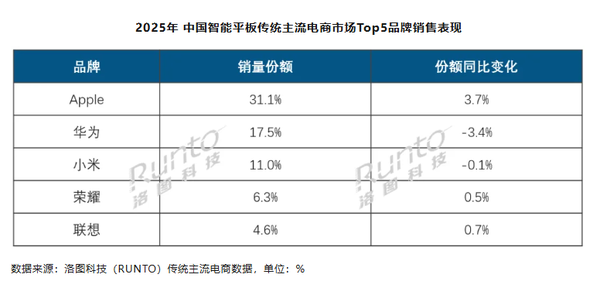
In the brand competition landscape, Apple leads the way with a 31.1% online sales share, a year-on-year increase of 31.3%. The 11th generation iPad has become the best-selling model of the year due to its high cost performance. Huawei ranks second with a 17.5% share. In the second half of the year, sales rebounded by improving the entire MatePad series matrix. Xiaomi (including Redmi) ranked third with a share of 11.0%. The dual-brand strategy has achieved remarkable results. Redmi has consolidated the thousand-yuan market, and Xiaomi has made a breakthrough into the mid-to-high-end market. Honor contributed nearly 40% of sales with its X series eye-protecting large screens and other features, while Lenovo achieved growth leadership through its Xiaoxin series productivity positioning and Savior series e-sports positioning.



 Login with Google