
 Gearbest Tech
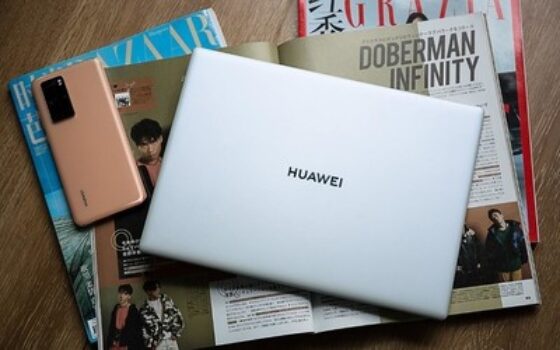
[Gearbest]When we focus all our attention on smartphones, what about the laptop market in Q1 2022?
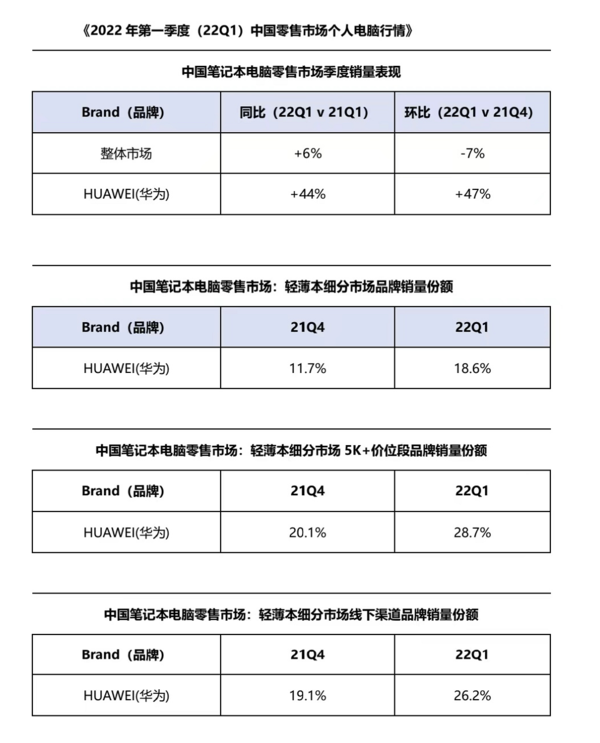
According to the latest data from market consulting agency GFK, quarterly sales in China's laptop retail market in Q1 2022 increased by 6% year-on-year and decreased by 7% month-on-month. The overall growth trend has slowed down. However, there are exceptions. Huawei's notebook computer retail market sales increased by 44% year-on-year and 47% month-on-month, achieving substantial growth against the trend. In addition, Huawei notebooks have more obvious sales advantages in mid-to-high-end positioning product lines and thin and light laptop offline channels. In the thin and light laptop retail market, Huawei's quarter-on-quarter growth rate in Q1 2022 was 59%, reaching 18.6%, and its share in the 5k+ price segment increased to 28.7%. At the same time, in thin and light offline channels, Huawei's Q1 share grew by 37% quarter-on-quarter, reaching 26.2%. All this also shows that the Huawei we are familiar with is back.
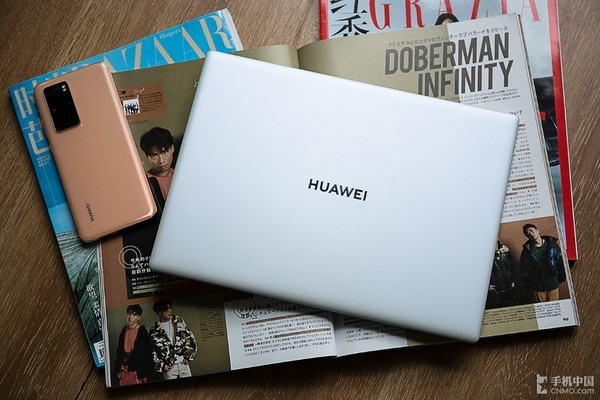
At the beginning of the year, we “counted” the notebook market in the past five years. We saw the rise of Huawei notebooks, from 0.5% market share in 2017, to 3.6% in 2018, 9.6% in 2019, 16.1% in 2020, and 8.0% in 2021. Huawei notebooks have had peaks and have also entered troughs due to various reasons. Now, with the rapid growth of Q1 sales in 2022, Huawei notebooks are expected to return to a market share of more than 10% this year.
Why are Huawei notebooks so successful? Facing this red ocean of laptops, what strategy has Huawei adopted for laptops?
Focus on the third generation of mobile office and create a brand logo exclusive to Huawei PCs
By 2022, Huawei will have been in the PC field for 6 years. In the past, we might have thought Huawei was still a new player, but now we see that it is already an old player that has experienced various industry changes. Since its entry into the market, Huawei has always followed the principle of “consumer-centered”, deeply cultivated the dual lines of PC wisdom + professionalism, made comprehensive improvements, and created a set of brand logos exclusive to Huawei PCs. Now, when it comes to multi-screen collaboration, Huawei Share, 3:2 ratio screen, super terminal, etc., consumers will basically think of Huawei notebooks. It is precisely because of this that Huawei notebooks have gained recognition from consumers at the overall level and achieved leading sales.
In addition, the report “Nine New Consumption Trends in Laptops in 2020” pointed out that in addition to paying attention to comprehensive performance and overall appearance design when purchasing notebooks, smart interaction has become a new focus for consumers when purchasing notebooks. Huawei notebooks precisely meet the needs of the third generation of mobile office. They not only meet users' needs for performance and productivity, but also meet everyone's expectations for the intelligence capabilities of notebooks. If you use Huawei notebooks and then use other products, you may still be a little uncomfortable. This is the charm of the product accumulated through years of iteration.
Finely divide the market, each product has its own strengths
Huawei notebooks are a collective term for all Huawei notebook products. If you choose according to your needs or budget, you will find that each of its series is very clearly divided. Huawei's MateBook X series is positioned as a high-end thin and light notebook, suitable for business people; Huawei's MateBook digital series is positioned as a performance notebook, with strong performance, outstanding appearance, and there is always one of the three sizes of 13, 14, and 16 that is suitable for you; Huawei's MateBook D series is positioned as affordable and affordable, with balanced configuration suitable for popular choice; Huawei's MateBook E series is a two-in-one, biased towards business, and its form is different from the X series to meet the needs of specific groups of people.
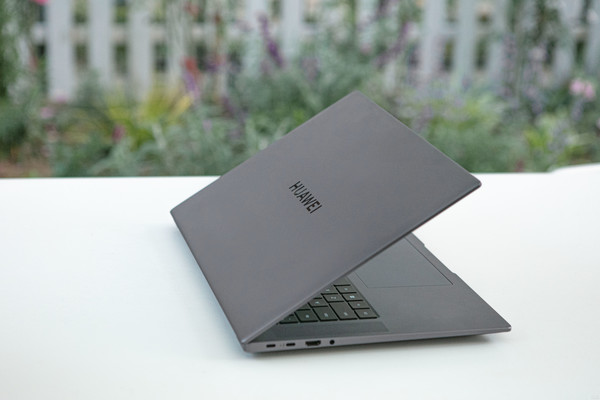
In addition, Huawei notebooks are very memorable in terms of appearance, hardware, software, intelligence, screen, humanized innovation, etc., each of which is a function built to meet consumer needs. For example, the appearance ID design of the MateBook On the D, the new Huawei Metaline antenna greatly improves the signal reception capability of the antenna and brings a better user experience; such as the pressure touchpad and air gestures, which are black technologies on the new MateBook
What is particularly obvious in consumer perception is that as Huawei's mobile phones, watches and other product lines are included in Huawei's smart ecosystem, Huawei notebooks, as C-level products in the “smart office” scenario, are gradually upgrading their smart capabilities. Huawei's sharing, multi-screen collaboration, multi-device files, smart search and other capabilities also bring consumers a unique smart experience. These are soft capabilities that cannot be solved by improving hardware.
write at the end
In fact, looking at the industry, the slowdown in the growth of the notebook market is not an isolated case. The smartphone market has even experienced negative growth. Against this background, it is a great test for the development strategies and product strategies of manufacturers. Nowadays, with the advent of the hybrid office era, it has also brought changes in user needs, and the notebook computer industry has entered a new turning point in its development. In the future, PC manufacturers will not only upgrade their products by improving hardware, but also build a brand moat in terms of software capabilities to better serve consumers with innovative experiences.
magicCubeFunc.write_ad(“dingcai_top_0”);


 Login with Google